Does ServiceNow Actually Have a CRM?

Source: Thomas Randall
At its World Forum event in Toronto on December 11, ServiceNow (NYSE:NOW) reinforced its CRM product line as a major facet of the platform’s portfolio. Officially launched in May 2025, continued acquisitions and capability releases have grown ServiceNow CRM’s scope across sales, fulfilment, and service solutions. In particular, ServiceNow’s new CPQ offering is directly tied to the company’s acquisition of Logik.ai in April 2025.
However, there are reasons for thinking that ServiceNow CRM is still not a full CRM in the traditional sense. Moreover, even if organizations find ServiceNow’s CRM still relevant to shortlist, the product’s adoption will have broader implications for one’s AI strategy. Given ServiceNow’s positioning of AI Control Tower as a centralized hub for governing and orchestrating agentic workflows, extending ServiceNow into CRM may meaningfully influence where and how your organization’s AI capabilities are developed and governed.
ServiceNow’s CRM Strengths
To address the headline: ServiceNow’s CRM is not yet a full-fidelity platform.
Info-Tech’s definition of CRM is a core enterprise application that provides a broad feature set for supporting customer interaction processes, typically across marketing, sales, and customer service. CRMs usually form the system of record for case management and data for organizations’ customers, which can be leveraged for a range of use cases by other best-of-breed applications (think of a hub and spoke model, where CRM is the hub and spokes might entail web experience, contact center, social media management, or point of sale). The best CRM software suites allow organizations to increase customer loyalty, improve marketing effectiveness, and boost sales productivity.
The importance of defining one’s CRM use cases will quickly filter ServiceNow’s relevance. ServiceNow focuses on scenarios covering customer service management, field service management, and sales and order management. Where ServiceNow lacks strength in core CRM capabilities is:
• Territory and quota management.
• Advanced contact and account relationship intelligence.
• Marketing automation and integrations.
• Intricate CPQ scenarios.
While ServiceNow has core advantages in case management and back-office data orchestration, the company has sought to expand and now market these capabilities as a CRM. ServiceNow can compete with the service elements of Salesforce or HubSpot but would be less successful in an organization focused on advanced sales and marketing requirements.
Acknowledging that ServiceNow does not constitute a full CRM in the traditional sense is a critical procurement consideration. Organizations seeking to extend their ServiceNow footprint into CRM must account for these functional limitations. More importantly, though, the way ServiceNow is positioned during the purchasing process has downstream implications for platform alignment, integration architecture, and where AI governance ultimately resides. This highlights a second, more strategic consideration: the role CRM is intended to play within the enterprise AI strategy.
ServiceNow CRM and Your AI Strategy
The opening of World Forum featured Idris Elba relaying the main concerns organizations have about AI implementation: siloed platforms, data mismanagement, and weak governance. The solution? Standardize on ServiceNow across major business functions to enable unified orchestration of data, governed through its AI Control Tower and executed via agentic workflows.
Rajeev Sethi, GVP, Enterprise Technologies at ServiceNow, reinforced this positioning by framing agents not as product-level features, but as an enterprise operating layer. Agent design emphasizes role- and persona-based deployment, with performance measured by detection latency, resolution velocity, and autonomous task completion rates. Governance emerges as a formal system construct, anchored in an AI asset registry and inventory, risk and compliance controls, and production monitoring via AI Control Tower. In this model, CRM data evolves from a mere system of record to a structural input for training, governing, and scaling enterprise agents.
This context reveals the deeper strategic consideration when evaluating ServiceNow’s CRM. The CRM is not positioned as a standalone application, but as a mechanism to pull customer data into ServiceNow’s broader ambition to become the enterprise AI control plane – the hub where organizations build, deploy, monitor, and audit AI agents across the organization. With AI Control Tower, ServiceNow is competing against other enterprise providers (such as Microsoft and Salesforce) to own the primary orchestration layer for agentic execution across business functions.
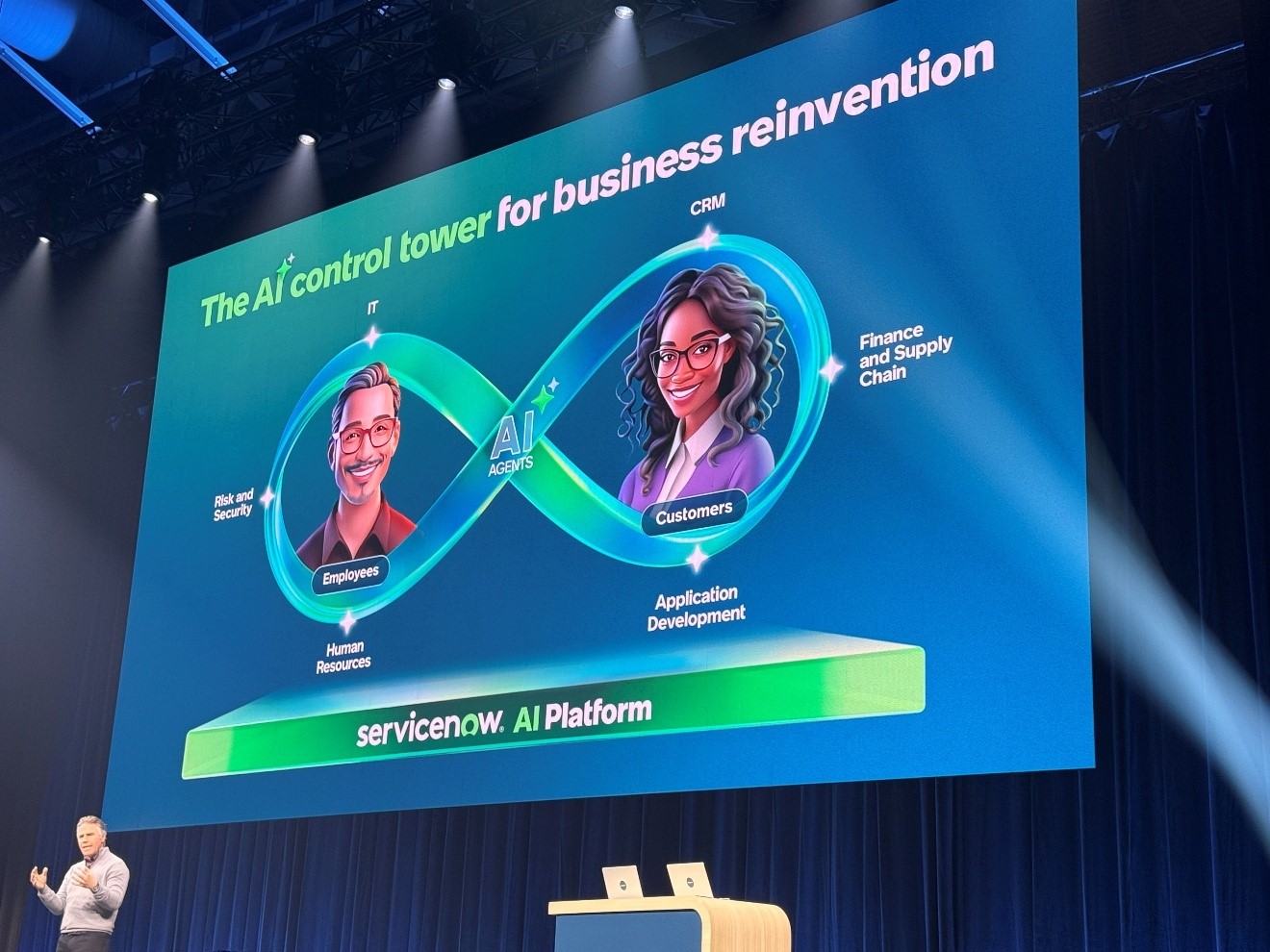
Photo: Nick Tzitzon, Vice Chairman at ServiceNow, delivers the opening keynote of ServiceNow’s World Forum event in Toronto. Source: Thomas Randall
Extending ServiceNow into CRM advances this objective by unlocking a high-value data domain: customer information. When customer data is unified alongside IT, HR, and supply chain workflows, ServiceNow strengthens its position as the organization’s dominant service management platform, reinforcing AI Control Tower as the default orchestrator of enterprise agents.
As such, decisions around ServiceNow CRM go beyond application selection and into core architectural considerations. CIOs must consider the organization’s broader strategy for where AI agent creation, monitoring, and governance takes place. Extending into ServiceNow’s CRM may introduce path dependency toward ServiceNow’s AI Control Tower.
Other CRM providers that can achieve feature parity with ServiceNow, such as HubSpot or Creatio, do not force the same strategic trade-offs. These providers lack ServiceNow’s cross-enterprise service management footprint and do not carry comparable ambitions to centralize AI governance.
Consequently, CIOs should treat ServiceNow CRM procurement as a strategic AI decision and ask: Does extending CRM into ServiceNow create implicit lock-in around AI governance and orchestration, and is that outcome aligned with the organization’s enterprise AI strategy?
Conclusion
While not a CRM in the truest sense, ServiceNow’s offering is a good fit for organizations looking to extend their ServiceNow usage for data orchestration between fulfilment, sales orders, and customer service management. However, CIOs must be mindful that there is an increasing architectural context to consider with ServiceNow’s agentic AI strategy.
Want to Know More?
• Agentforce 360 – Marketing Ploy or Genuine Transformation?
• Customer Relationship Management Selection Guide