Salesforce Data 360 and Snowflake
Significant differences between Salesforce Data 360 and Snowflake that may lead to a decision to use both.
Data 360
As per Salesforce, Data 360 is the next evolution of Data Cloud. It “transforms fragmented data scattered across your enterprise into one” – which may lead the reader to believe that it is a data consolidating facility similar to a traditional data warehouse. However, technically, Data 360 enables Zero Copy integration of data from different sources into one virtual hub. That is: the data is accessible via the centralized access point, but it is not necessarily assembled (copied over) into a centralized repository and available for further data engineering. This architectural pattern would work well if all your sources deliver Data as a Product – i.e. clean, accurate, and well-formed for consumption.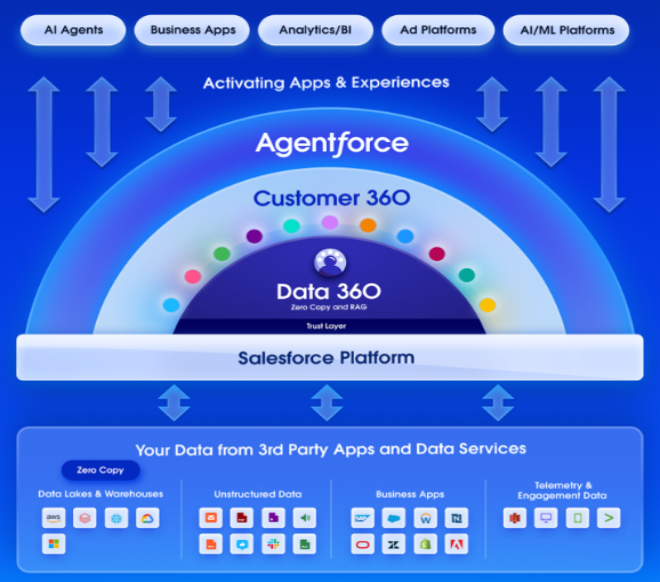
Image source: Salesforce
It also should be noted that Data 360 is positioned as the data hub for Customer 360, which makes perfect sense in the context of Salesforce but limits analytics through the customer-focused lenses. It will be easy to build a “know your customer better” solution, but building solutions that require different data models – like operational optimization or supplier risk management – may not be as easy.
Thus, Data 360 enables centralized access to various data sources and easy integration of such data based on the customer-focused canonical model, but it cannot be regarded as a general-purpose data warehousing platform.
Snowflake
Snowflake is designed to be a general-purpose data warehousing platform that is not specifically optimized for any particular use case out of the box. It offers industry-specific solutions that use specific data standards (e.g. HL7/FHIR for Healthcare), but the user is free to choose any of those or build their own. Snowflake does store actual data offering various types of data storage and access technologies for structured, semi-structured and unstructured data; however, the latter should not be considered as a document or digital asset management facility but rather as a convenient storage for easy AI access to the unstructured data assets.
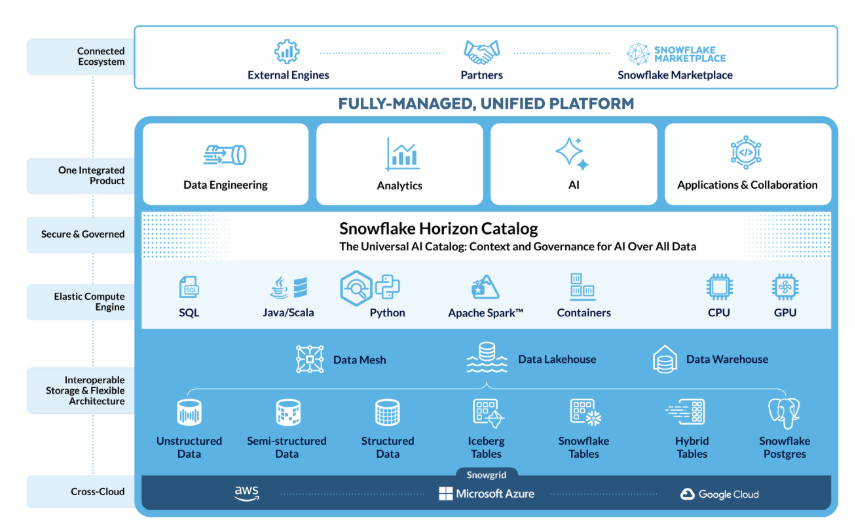
Image source: Snowflake
Speaking of AI, it should be noted that Snowflake does not support graph storage natively – only via integration with Neo4j, which provides Labeled Property Graph (LPG) type – not RDF/OWL (please, read our earlier article about the importance of Ontologies and Graphs for AI agents).
Snowflake is open to various data management tools to run natively atop its data storage enabling data quality management and data augmentation, as well as building various analytical pipelines and solutions. It provides a unique capability of sharing data with external parties without moving this data outside of the tenant. It also supports the publishing of various data products at its marketplace for sharing across the platform.
Thus, Snowflake offers centralized data storage enabling various data management activities, the creation of different analytical solutions, and the sharing of data across the platform and with external partners.
Our Take
Info-Tech’s SoftwareReviews site classifies Snowflake as an analytical data store and Salesforce Data 360 as a custom data platform, which is consistent with the overview above. These platforms should be considered complimentary rather than mutually exclusive. The decision to have both or only one should be based on the use cases to be enabled.
Data 360 would be most suitable when a customer data platform is of high priority. In most cases, Data 360 is going to be an ecosystem play for clients already heavily invested in SFDC elsewhere; therefore, it would not be recommended for “vanilla” greenfield selections in the CDP arena.
Snowflake should be considered for multi- or cross-domain analytics, especially when data sharing with external partners is important.
Additional hint: if both platforms are required, Informatica could be used as a well-integrated multi-functional software bridge, enabling multi-domain MDM, data quality, and data governance across both Data 360 and Snowflake. Additionally, Informatica’s metadata can be serialized as graph (albeit LPG) that can be used by AI agents running across both platforms.
Want to Know More?