ServiceNow's CRM Advances Come With an AI Architecture Decision
ServiceNow’s World Forum 2026 in Toronto did two things. First, it established ServiceNow as a serious player in enterprise CRM, especially for CPQ functionality. Second, it revealed that the architectural implications of choosing ServiceNow are even more consequential for organizations’ AI strategy.
Infotech’s assessment of 2025’s World Forum warned that adopting ServiceNow CRM could influence where organizations build and implement AI agents. This year’s developments reinforce that concern. As customer processes (spanning order management, fulfillment, field service, and so on) become executable through AI, ServiceNow is serious about land grabbing your agentic architecture.
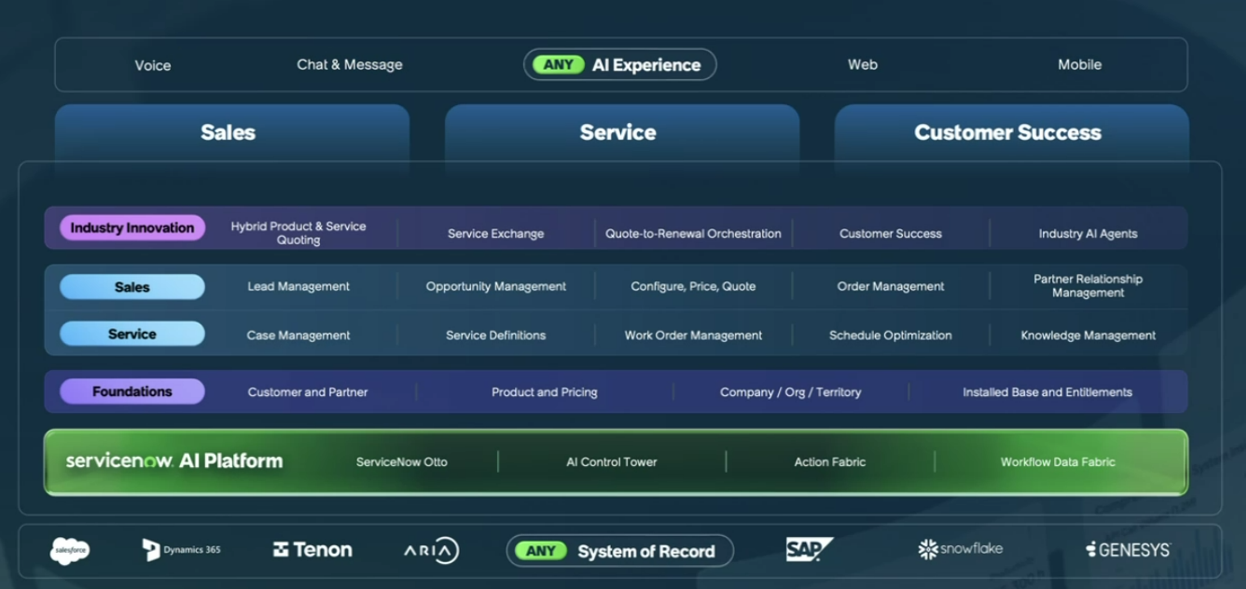
Image: ServiceNow’s CRM overview. Source: Infotech/ServiceNow
briefing.
Advances in ServiceNow CRM
ServiceNow advertises its CRM portfolio around the ability to sell, fulfill, and service on one platform. Sales automation, CPQ, and order management connect to customer service and field service, with workflows extending into ServiceNow’s middle- and back-office modules. The value proposition of ServiceNow CRM addresses a pain point typically found in other CRM platforms: capturing a request is relatively straightforward, but completing it often requires employees to coordinate across multiple systems.
ServiceNow Otto now provides a conversational entry point into those processes, linking them all together across the ServiceNow platform. Introduced at Knowledge 2026, Otto brings together Now Assist, Moveworks, and AI Experience. Within CRM, sellers can use Otto to review opportunities, update records, and progress deals. Otto also simplifies CPQ capabilities, including summarizing products, pricing, discounts, and negotiated terms. ServiceNow also documents submitting quotes for approval and acting on approval requests through external MCP clients, such as Claude Desktop.
ServiceNow’s Sales CRM scope now encompasses lead and buying group orchestration, pipeline management and forecasting, territory management and planning, CPQ, order management and operations, partner relationship management, and customer lifecycle and success. Buyers should assess the maturity of each capability against their requirements, but ServiceNow’s breadth warrants revisiting earlier assumptions about ServiceNow’s suitability for enterprise sales.
The underlying CPQ functionality is particularly significant for enterprise buyers. ServiceNow supports attribute-based configuration for complex products, with rules that guide selections and calculate values as users configure an offering. Its broader quoting capabilities encompass price lists, discounts, approval workflows, quote documents, and contractual sales commitments. Configuration also extends to changes involving products already sold and associated contracts. At World Forum, ServiceNow emphasized a dynamic rules engine that applies relevant logic as a configuration develops, in contrast to CPQ systems that run through all rules before providing a quote (which causes processing delays). Together, these capabilities support enterprises selling customizable offerings across direct sales, partners, and digital channels.
ServiceNow CPQ, as a standalone product, remains an entry point into organizations using another CRM. ServiceNow documents embedding its configuration engine within Salesforce, ecommerce platforms, and custom applications. ServiceNow can therefore compete for configuration and quoting while an incumbent CRM retains opportunity management. Connecting those commercial decisions to order management and fulfillment gives ServiceNow a route to expand its responsibility across the revenue lifecycle. Headless and composable delivery also allows organizations to access those capabilities through different interfaces, including preferred AI assistants.
Voice provides another route into the platform. Organizations can retain their CCaaS provider for telephone numbers and telephony connectivity, routing calls to ServiceNow AI voice agents to perform customer tasks. ServiceNow also supports native WebRTC interactions, allowing customers to speak directly to an AI voice agent through a browser or mobile application without passing through a CCaaS platform or requiring a provisioned telephone number. This extends voice automation into digital self-service while preserving an integration path for existing contact center infrastructure.
The roadmap presented at World Forum shows how ServiceNow intends to develop this architecture. It placed multimodal interfaces and model flexibility in Q3 2026, followed in Q4 by signal ingestion, a Customer Context Graph, and automatic capture and correlation of first- and third-party data. These developments are intended to structure conversational and customer information so agents can act with more relevant context. ServiceNow’s 2027 direction extends toward “Autonomous Sales” CRM and a sales orchestration operating system.
Super Intelligent Control Tower Extends ServiceNow’s Architectural Land Grab
ServiceNow’s value proposition for AI governance explicitly reveals its ambition to be organizations’ primary agentic control plane. Super Intelligence (SI) Control Tower is ServiceNow’s solution to inventory and govern AI across the enterprise, including agents supplied by other vendors. Organizations will soon be able to use ServiceNow for shadow AI detection, access mapping, and agent cost and value measurement, with availability in Q4 2026.
The acquisitions of Veza and Armis support ServiceNow’s ambition. Veza contributes visibility into identities and their permissions, while Armis contributes intelligence about connected assets and their exposure. Connecting that information to ServiceNow’s workflows strengthens its ability to determine which systems an agent can reach and the potential consequences of its actions.
Of note is a forthcoming solution called AI Passport. Announced in October and expected for GA in Q4 2026, AI Passport uses signed credentials to establish any agent’s authorized scope, including delegated permissions as work passes between agents and tools.
To see this in action, consider an agent handling a customer’s request to change an order. The agent may need to revise a configuration, apply a discount, change fulfillment instructions, and request a billing adjustment. Permission to access the customer record does not establish authority to perform every subsequent action. A governance layer must determine which actions are permitted, when approval is required, and whether a second agent inherits appropriately limited authority. If ServiceNow supplies those controls, its architectural role extends into transactions executed across other enterprise systems.
Of course, adopting the Control Tower is not an inevitable outcome of using ServiceNow. Organizations can assign the platform a defined role within a broader architecture. That discussion is not just about using ServiceNow for ITSM vs. CRM vs. procurement, etc. There needs to be explicit decisions about AI strategy: where agents run, which platform authorizes transactions, how policies apply across systems, and which records provide authoritative evidence of execution. Perhaps ServiceNow is the best platform for your organization to do this, but we should not sleepwalk into it.
Our Take
ServiceNow is using a legitimate governance problem to justify a much larger platform mandate. Enterprises need visibility into agents, their permissions, and their actions. ServiceNow’s proposed solution is to oversee AI supplied by its competitors as well as its own applications. For buyers, the trade-off is that reducing governance fragmentation may concentrate dependencies around the vendor maintaining operational context, approval processes, and execution records. ServiceNow’s support of third-party agents does not, by itself, demonstrate that those dependencies are portable.
ServiceNow must also establish why it should own these controls in the first place. Otherwise, Control Tower risks adding another policy layer and dashboard to the fragmentation it promises to resolve. There is plenty of competition from providers making similar claims about governing third-party agents and exposing shadow AI. Microsoft Agent 365 extends agent administration into its identity and security environment. IBM watsonx.governance discovers unmanaged AI assets across supported development platforms. And security suppliers such as Palo Alto Networks are expanding agent discovery and protection. Cross-platform oversight is a contested capability.
As such, CIOs should be mindful of the difference between buying effective CRM capabilities and granting ServiceNow broader architectural authority. Over the past year, ServiceNow has earned a stronger position in enterprise CRM evaluations, particularly where complex quoting connects to fulfillment and service. Infotech’s previous assessment questioned the completeness of ServiceNow’s CRM platform. Some reservations remain: native marketing capabilities are still missing (indeed, ServiceNow partners with Tenon to deliver those). But sophistication in CPQ certainly warrants a second look, especially when ServiceNow CPQ is composable.
ServiceNow’s strongest competitive opportunity is to challenge other CRM providers in owning the entire revenue lifecycle. ServiceNow can enter a tech stack through configuration, quoting, order management, or service while another vendor retains the sales application. Buyers must be aware, though, that ServiceNow’s commercial interests favor an expanding platform footprint. ServiceNow’s advantage will vary with the customer’s architecture, but buyers should expect these competing CRM vendors to contest both the application spending and the authority to orchestrate agents.