AI Agents Are Calling: NiCE’s Vision for the Future of Customer Service
Most people have better things to do than call customer service. We all put off disputing a charge, chasing a refund, or changing a reservation because we know how much time it could take. Sometimes we give up altogether and just don’t bother. Personal AI agents could change that effort calculation. A customer can now ask an agent to resolve a problem and get on with their day. The agent handles the calls, navigates the website, and follows up.
At NiCE’s 2026 Analyst Summit, Chief AI Officer Phil Heltewig captured the shift in one line: “the customer’s agent will become the channel.” For customer service, the implications are significant. Enterprises have spent decades deploying AI to serve customers, and now they must prepare for AI that arrives on the customer’s behalf.
Personal AI agents will change who starts an interaction, how the journey unfolds, and what a business must verify before it acts. NiCE is preparing its technology to meet this wave of change.
Customers will delegate the work of getting service
Consider a traveler whose flight has changed. They need a different hotel arrival date, confirmation that their room will be held, and perhaps a refund for a night they can no longer use. Today, the traveler often coordinates those requests. A personal agent could pursue them while the traveler deals with the disruption itself.
Persistent customer agents may go “channel shopping” or “agent shopping” to get the desired outcome on behalf of the customer, driving up volumes across all channels. The business may receive a phone call, a chat, a form submission, and a request through social. Each is part of work the customer has delegated. The service experience now includes how effectively the enterprise works with that customer agent representative.
Hyatt reported seeing this activity already. At the summit, its representative described personal-agent interactions emerging in Asia and increasing in the Americas, including agents communicating with Hyatt’s own AI.
Current demand forecasts reflect how much inconvenience people tolerate
Service demand has always been constrained by the scarcity of human time. Customers cannot spend every afternoon pursuing a billing correction or comparing renewal offers. An agent could make those requests worthwhile.
NiCE CEO Scott Russell predicts that personal agents will multiply service demand. Hyatt’s experience supports the direction of that argument, although the scale remains uncertain. David Mayer, VP of Data, Analytics, Learning and Quality Strategy at Hyatt, acknowledged the difficulty of planning without historical baselines.
The implication for enterprises is that past contact volumes may understate future demand. They show the requests customers were willing and able to make in a timeline when personal agents weren’t available. These agents could now expose needs that previously went unaddressed, leading to an exponential increase in volume. We are already seeing this increase with agents on non-voice channels.
AI persistence creates another complication. An agent might retry a request or approach the business through several entry points. Service platforms will need to connect those attempts to the same customer goal and deliver a true omnichannel experience. Otherwise, enterprises risk processing duplicate work, issuing inconsistent answers, and paying for repeated interactions that make little progress.
The business will have less control over the route
Companies design service journeys around their own websites, apps, menus, and organizational boundaries. Customers already work around those structures, even when they are inconvenient. Personal agents could do so more persistently. We expect customers to adopt agents for any interaction that cannot be resolved immediately. The ability to eliminate waiting in queues will be one of the strongest drivers of adoption of personal agents.
An agent asked to obtain a refund may try chat, call the service center, and then follow up later. Its instructions come from the customer and will no longer be constrained by time (see diagram 1 The Persistent Customer Agent).
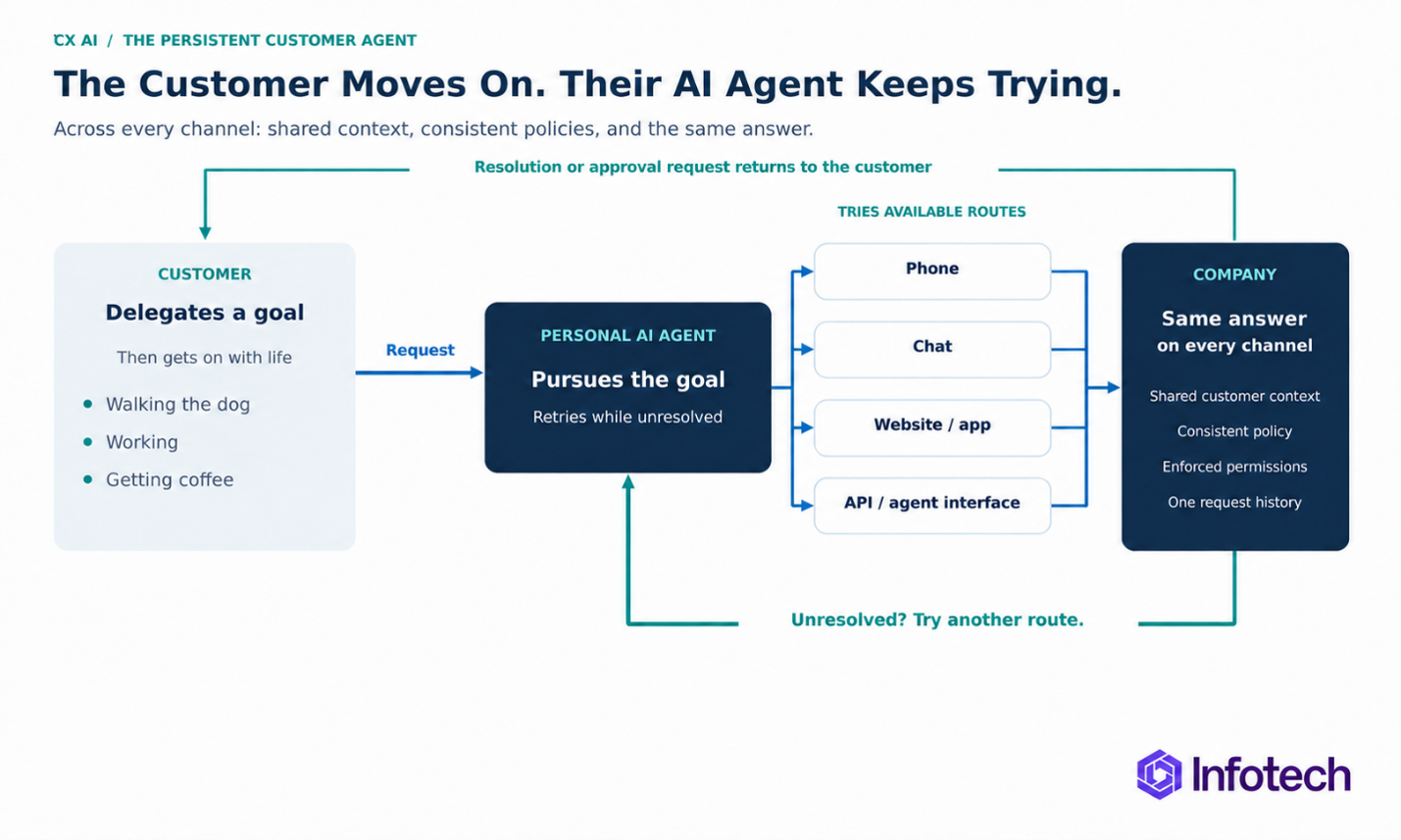
The business cannot assume it will follow the preferred sequence of screens or remain within one channel. This raises the cost and likelihood of fragmented service. As interaction volumes grow and channels multiply, friction in the customer journey will become more apparent. Entry points often hold different information, with no shared view of the customer or work already underway. An AI agent navigating these disparate channels will increasingly encounter conflicting policies or initiate duplicate requests. NiCE sees the implication and states that they are building the technology stack that will be needed to support this increasingly complicated customer and agent journey.
Enterprises need a consistent understanding of the customer’s request wherever it arrives. That includes what has been attempted, which commitments have been made, and what remains unresolved.
Delegated authority must have limits
A convincing voice does not establish identity. Recognizing that a caller is an AI agent does not establish permission to act. The Personal Agent Protocol that NiCE is helping to shape could provide a common way to authenticate agents, communicate delegated authority, and place limits on what they can do. As personal agents become more common, these controls will become increasingly necessary, and enterprises will need to enforce them consistently.
A customer might authorize an agent to check a reservation while retaining approval over cancellation. They might permit purchases up to a specified amount or allow access to one account for a limited period. Enterprises must verify those boundaries before releasing information, changing a record, or completing a transaction.
The first few years will likely be messy. Courts and regulators will need to determine what happens when an agent misinterprets a request or takes an action the customer did not intend. Is the customer legally bound by the decision? Who bears the cost if reversing it creates a loss for the organization? These questions become even more complicated for multinational companies operating across different privacy, consumer protection, financial, and AI laws. A shared protocol can provide the technical foundation, but it cannot create consistent legal treatment across jurisdictions.
IT and service leaders should determine which actions require direct customer confirmation, how delegated permission is recorded, how long it remains valid, and how it can be withdrawn. The same restrictions must apply across channels and connected systems.
NiCE said the Personal Agent Protocol was still being developed at the time of the summit. Buyers should evaluate the authentication, authorization, consent, and audit controls available today while tracking how the protocol develops. They should not assume that an emerging technical standard will resolve the remaining questions about liability, enforcement, and legal authority.
Our Take: The Future of CX AI & NiCE’s Advantage
The customer’s agent adds a new (and relentless) participant to an already complicated service environment. Enterprises should prepare by choosing a realistic delegated task and testing the full journey, including failed attempts, approval requirements, and follow-up through another channel. Technology will be a key part of this journey, but it must rest on a strong omnichannel CX foundation that underpins the entire strategy.
NiCE’s CX AI strategy addresses this need through shared work items, experience memory, and orchestration across human and AI workers. Buyers should assess whether these capabilities preserve context and accountability through to resolution, and distinguish products available today from the early access and roadmap capabilities shown at the summit.
Service leaders must accept that this is the future. Refusing to support AI agents that act for customers may feel like a natural reaction, but it will not be a viable strategy in two, three, or four years. Customer expectations are shifting, and quickly.
Instead, we recommend that leaders measure whether requests were completed accurately, how often they had to be repeated, and what they cost to resolve. Containment alone cannot answer those questions, and we believe it will soon be an outdated measure of success.
Businesses that make delegation difficult will simply pass that difficulty on to their customers. Enterprises must support delegation while keeping control over access, commitments, and execution. Supporting an authorized personal AI agent well could become part of what makes a company easy to do business with and a meaningful part of an excellent, AI-enabled customer experience.
Want to Know More?
- Contact Center as a Service Selection Guide
- NICE: How AI Is Used to Deliver Effective Customer Experiences
- Cognigy Now Central to NICE’s Agentic Operating Model
- NICE Unveils Vision for a CX-Powered Contact Center of the Future
- NICE Case Study: AI for Customer Experience
- NICE Enlighten AI: The Kiss of Death for Traditional Call Centers
- NICE Accelerates Toward an AI-Orchestrated Future for CX
- The Rise of Proactive AI in Enterprise CX