Zoho Analytics Becomes Context for Agentic AI
Image source: Zoho
Zoho is repositioning Zoho Analytics from a business intelligence (BI) and reporting tool into a “context layer” for agentic AI, which includes native semantic and ontology layers, a multi-agent version of Ask Zia, and built-in governance.
Zoho Analytics becomes the intelligence layer for business operations, combining shared business definitions, an ontology, and agents that can move from analysis to workflow execution. The strongest potential value is a more integrated route to governed automation for Zoho customers. Zoho also says the product will become a full unified data platform with a lakehouse over time.
Key Capabilities
|
Area |
Detail |
|
Semantic layer |
No-code business glossary covering descriptions, synonyms, instructions, and metrics. Supports multiple semantic models, e.g. finance, operations. Claims compatibility with Apache Ossie for portability. |
|
Ontology layer |
Tools to model canonical business entities and their relationships, giving AI a structured view of the organization. |
|
Ask Zia |
Multi-agent architecture with one orchestrating agent and six prebuilt sub-agents: analysis, modeling, visualization, data prep, coding, and actions. Shared semantic layer, ontology, and conversation memory. Customers can use Zia’s own LLM or bring their own frontier model. |
|
Custom agents |
Customer-built agents grounded in the same data, semantic model, and knowledge base. They connect to MCP servers, web search, and other tools and can be distributed with governance controls. |
|
Agentic actions |
Agents can trigger workflows through a workflow builder and contextual action triggers. |
|
Headless BI/MCP |
Remote and local Zoho Analytics MCP servers (analysis, data prep, visualization tools), a new CLI, and a Claude plug-in. |
|
Embedded AI |
White-label agents embeddable in customer apps and portals, with permissions and governance carried over. |
|
Governance |
Data catalog with lineage and impact analysis. AI observability (which agents ran, who used them, what they accessed, usage and cost tracking). Sandbox-to-production deployment with rollback. |
|
Deployment |
Zoho Cloud, on-premises, AWS, Azure, Google Cloud, and hybrid. |
Stated Roadmap
- Dynamic business context: Continuous observation of how business data changes, extending today’s “designed” context.
- Decision tracking: Capturing outcomes of agent-triggered actions as “Decision Intelligence.”
- Openness: Following the Ossie specification as it matures, ingesting semantic models from third-party platforms, and exposing more of the platform via MCP.
- Unified data platform: Evolving into a lakehouse for structured and unstructured data, with data integration, preparation, analytics, data science, and agent building.
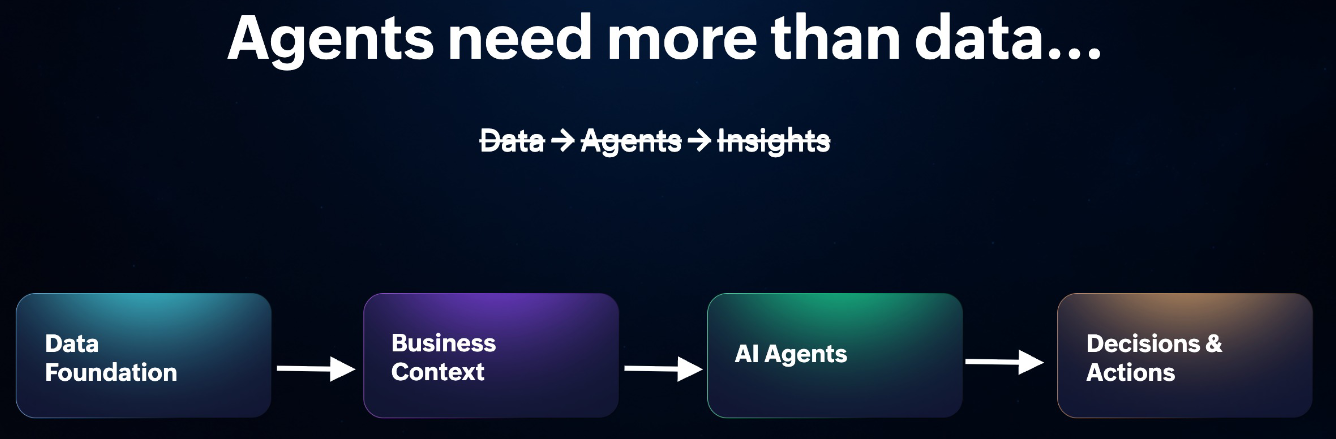
Image source: Zoho
Comparison With Competition
Many vendors offer native semantics and ontology (e.g. Microsoft, Snowflake, AWS, Oracle, Teradata, Databricks, Salesforce – see the links to our earlier publications at the end of this article). Therefore, Zoho’s differentiation is an integrated BI and agent environment.
For Zoho customers, tighter application integration could reduce assembly work. For organizations established on Fabric or Snowflake, the question is whether Zoho can reuse existing definitions and permissions via MCP without creating another context layer.
What CIOs Should Watch Out For
Availability and total cost. Obtain a feature-by-feature matrix for general availability, editions, regions, and deployment options. Ask for pricing, consumption limits, and support commitments.
Governance of business meaning. Require ownership, approval, and versioning of business definitions. Ask for explanations of joins, groupings, exclusions, and calculations behind derived results.
Permissions and data movement. Test the full path from source access to embedded answers and external actions, including tenant isolation, row and column controls, and agent memory. Identify whose credentials each tool uses and which data reaches each model provider.
Control of actions. Require explicit authorization for writes, human approval for specified actions, and controls for retries and duplicate execution. Distinguish rollback of an analytical output from reversal of a transaction in an operational application.
Interoperability. Apache Ossie, formerly Open Semantic Interchange, is an incubating specification for exchanging semantic metadata. Compatibility is encouraging, but buyers should test import and export with their actual models, calculations, relationships, and target tools. The release does not establish RDF/OWL support, formal reasoning, or equivalent execution across platforms.
Our Take
Zoho claims that analytics definitions can and should become shared context for agents that act across business applications; i.e. the semantic and ontology layer belongs inside the BI tool rather than in a separate data platform or warehouse. For small and mid-sized organizations, especially those already running Zoho applications, that lowers the barrier to grounding agents in governed business definitions. The most evident advantage is reducing the work needed to connect BI, business context, and workflows, particularly within the Zoho ecosystem. The built-in observability, cost tracking, and sandbox-to-production controls address real concerns about running agents at scale.
CIOs should pilot one bounded workflow and measure answer accuracy, authorization fidelity, task completion, latency, and total cost. Treat dynamic context, decision tracking, and the full lakehouse as roadmap commitments: the release explicitly places them in its future plans. Expand adoption only after the announced capabilities prove reliable on real business data.
Portability depends on the specification (Apache Ossie), which is still in the incubation state, and multi-platform organizations should assess how Zoho’s semantic models interoperate with those defined in AWS, Oracle, SAP, or Microsoft environments. Zoho’s commitment to ingest third-party semantic models is stated as future work.
Want to Know More?
- Zoho’s Quiet Enterprise Coup: A Unified Platform Built for the AI Era
- Microsoft Adopts Ontology-Based IQ Layer for Agentic AI
- Snowflake Announces Expansion of Snowflake Intelligence and Cortex Code
- Oracle: Integrating AI Data Platform, Fusion Data Intelligence and OCI Enterprise AI
- Teradata Provides Smart Context and Spreads to OneLake
- AWS Context Turns Enterprise Knowledge Into Reusable Agent Intelligence
- Databricks Is No Longer Just a Data Company
- Dreamforce 2026: Data 360, Tableau, Informatica