Dreamforce 2026: Data 360, Tableau, Informatica
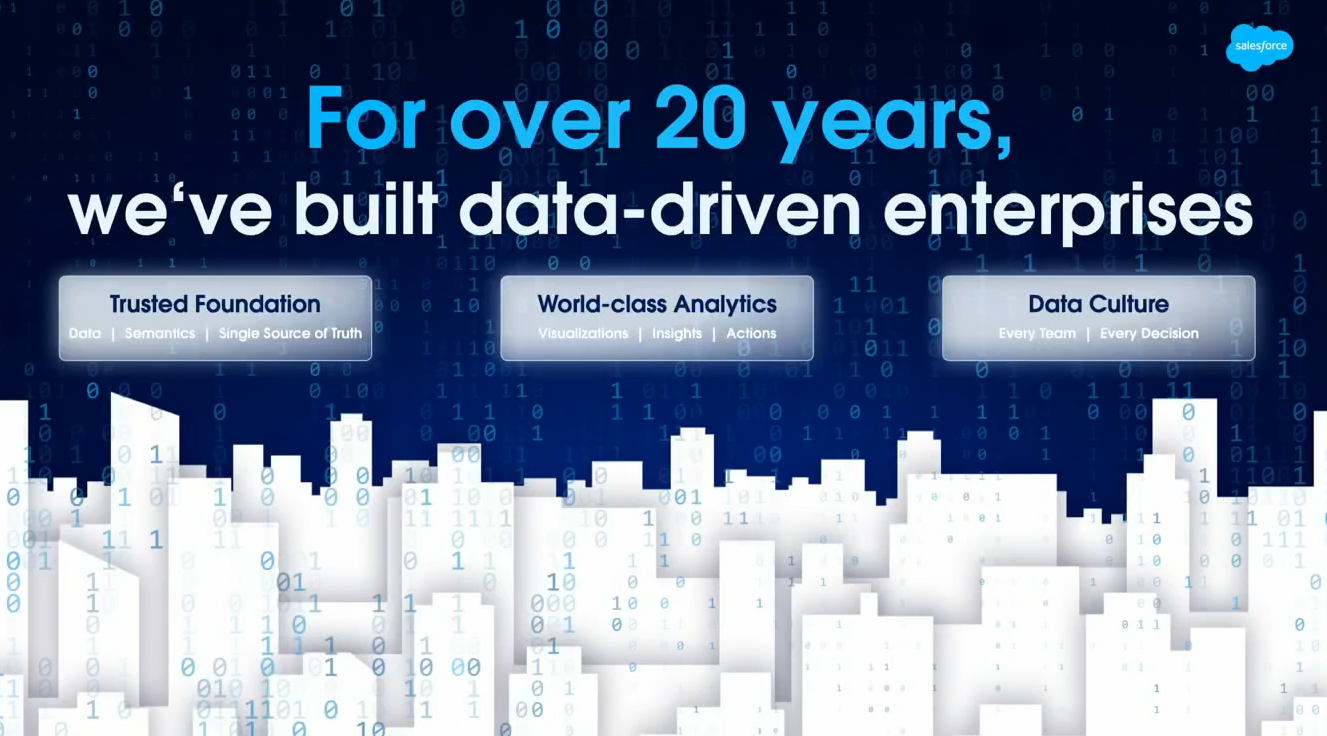
Image source: Salesforce
Dreamforce 2026 exploded with a number of significant announcements. Let’s have a look at the three products related to data and BI: Data 360, Tableau, and Informatica. Salesforce summarizes how this trio contributes to its overall Agentic AI strategy as: Data 360 provides data and context, Informatica makes the data AI-ready, and Tableau provides semantics for AI agents.
Data 360
Image source: Salesforce
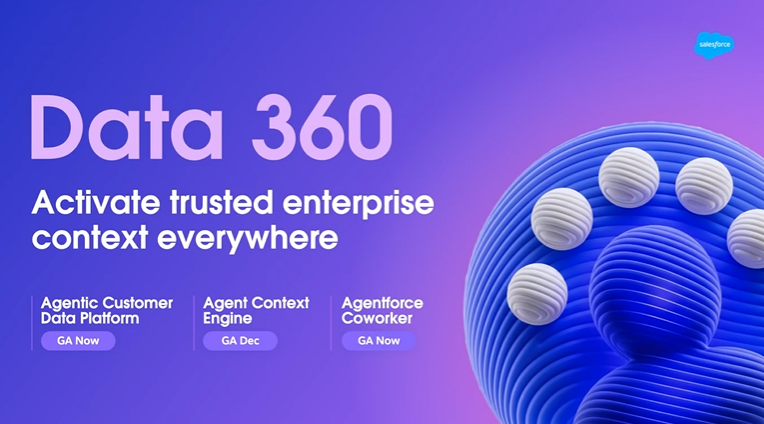
Data 360 is being repositioned from a customer data platform used primarily by Salesforce applications into a governed context service available to any authorized agent or interface. The principal Data 360 development is Headless Data 360. Through its MCP server (in GA), authorized agents can access nearly two hundred Data 360 APIs and perform operations – not merely retrieve customer records. Claude, ChatGPT, Slackbot, Agentforce, and custom applications can potentially consume the same customer context while inheriting Salesforce permissions and governance.
Data 360 is now not just the place where customer profiles are unified, but the runtime context layer between enterprise data and AI agents. Its limitation remains the same as before: Data 360 is strong at customer, interaction, activation, and Salesforce application context, but it does not by itself provide the enterprise-wide integration, quality, catalog, lineage, master data management (MDM), and governance capabilities of Informatica. Salesforce is therefore treating the two as complementary rather than trying to stretch Data 360 into a complete enterprise data management platform.
Zero-copy has been extended to Google’s BigQuery: direct query federation from Data 360 into BigQuery, plus data sharing from Data 360 back to BigQuery.
A bit complicated, but mainframe data is becoming available in Data 360: IBM Data Gate makes IBM Z data available through watsonx.data, then Data 360’s GA watsonx.data connector performs zero-copy file federation over Apache Iceberg tables.
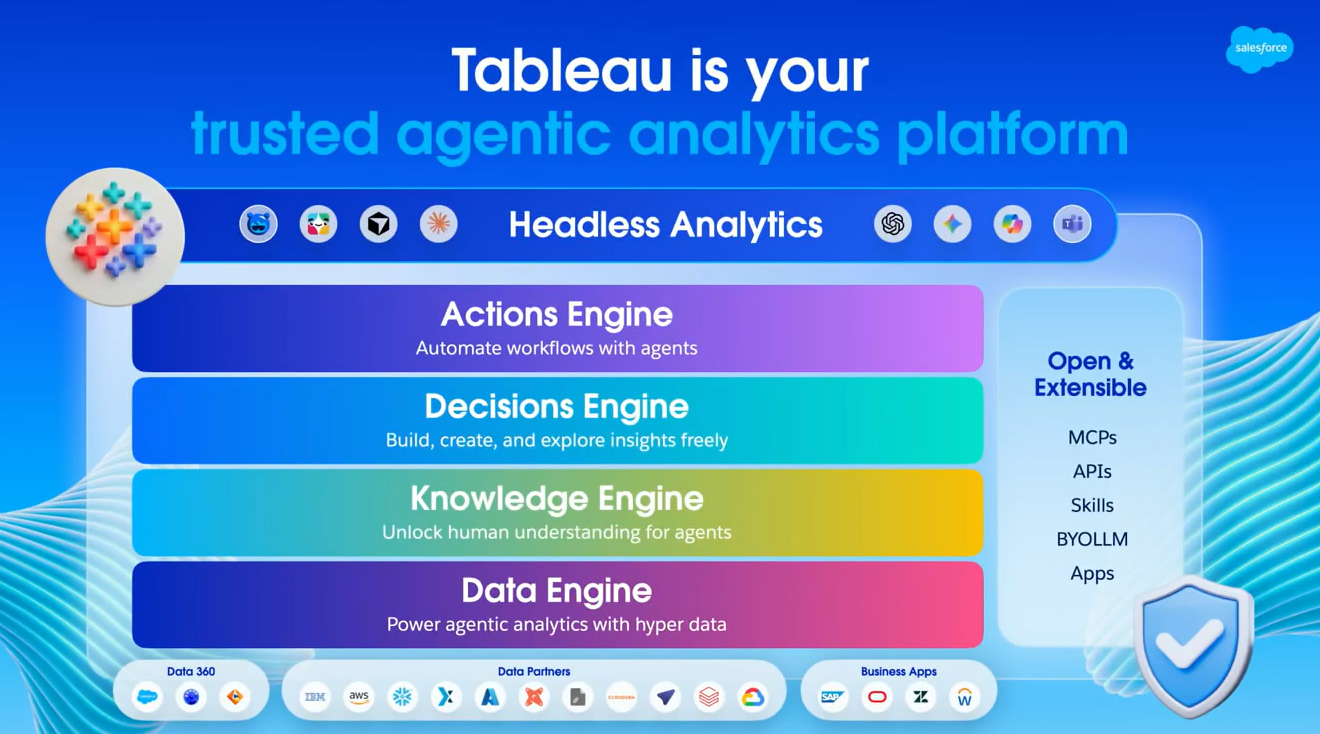
Image source: Salesforce
Tableau
Tableau’s message was “agentic analytics”: analytics delivered proactively inside operational workflows rather than requiring users to open dashboards. It now revolves around several capabilities:
- Tableau Semantics and Auto Knowledge Graph provide governed metrics, relationships, business definitions, and analytical context.
- Tableau Agent supports conversational analysis and follow-up questions.
- Tableau MCP servers expose governed Tableau knowledge to external agents and interfaces.
- Agent Actions allow analytical findings to trigger workflows.
- Agentic Analytics Command Center provides visibility into analytics agents, the data they access, and their behavior.
- Headless analytics delivers Tableau insights through Salesforce, Slack, Teams, Claude, and embedded applications.
Tableau’s strategic role is changing: it’s no longer just a tool to design pixel-perfect complex dashboards – it now provides the business meaning and analytical reasoning layer. For example, Tableau defines what “revenue,” “service performance,” “churn risk,” or “profitability” actually mean – and helps agents reason from those definitions.
The key question remains open: whether Tableau Semantics and its Auto Knowledge Graph can become a genuinely open enterprise semantic layer or remain predominantly optimized for Salesforce and Tableau.
Informatica
Image source: Salesforce
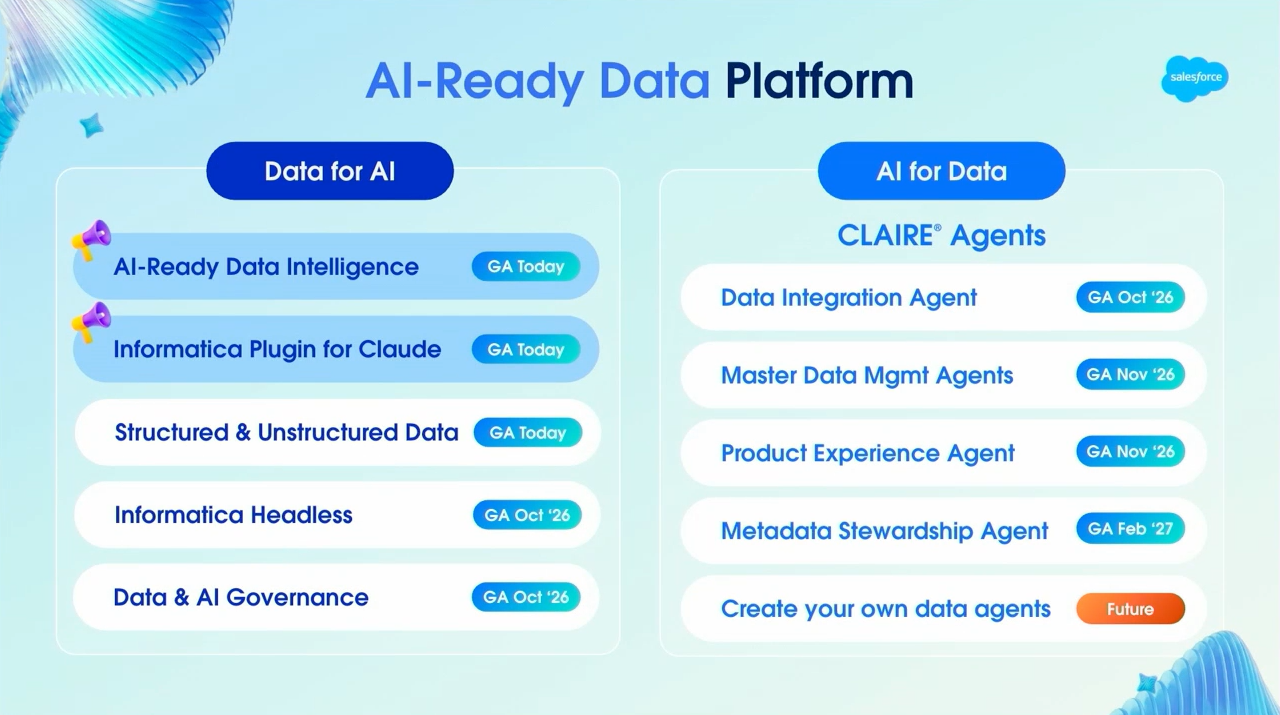
Informatica had the most substantive set of newly announced data management capabilities.
AI-Ready Data Intelligence
This new self-service solution evaluates data across seven dimensions:
- Discoverability
- Quality
- Context
- Accessibility
- Governance
- Trust
- Observability
Customers can ask Claude to assess tens of thousands of cataloged objects, identify readiness gaps, and recommend remediation. It is available to Informatica catalog customers through Claude. This represents a useful shift from generic “AI readiness” assessments to evidence drawn from actual metadata, lineage, quality, and governance information.
Informatica Plugin for Claude
A new Claude Platform plugin brings Informatica-managed data intelligence into Claude Code and Claude Cowork. Prebuilt skills cover:
- Catalog discovery
- Metadata exploration
- Lineage
- Data-quality assessment
This is an important example of Salesforce making Informatica available outside Salesforce interfaces rather than absorbing it into a closed CRM stack.
Agentic data management
Informatica also announced:
- Informatica Headless: Data-management capabilities accessible through Claude, Slack, VS Code, Cursor, and other environments.
- Unstructured Data Cataloging: Automated extraction and classification of metadata from PDFs, text, and documents.
- MDM Agents: Assistance with configuration, duplicate resolution, and stewardship.
The MDM announcement is especially notable as Salesforce claims these agents can reduce some mastering and configuration activities “from months to hours,” although that should be treated as a directional vendor assertion. Complex match-rule design, survivorship, governance, and stewardship operating models will not become fully autonomous simply because configuration is agent-assisted.
The larger architectural announcement
Salesforce’s Enterprise AI Harness combines six trusted capabilities:
- Context
- Agency
- Action
- Governance
- Security
- Models
Harness brings business grounding. For example, if an AI agent recommends a 19% discount for a customer, the Harness may correct it to 15% as the established maximum allowable discount. Informatica is an integral part of the Harness.
A new AI Control Plane is intended to register agents, apply identity and policy, manage lifecycle, evaluate performance, observe behavior and outcomes, and control costs across Salesforce and third-party AI. Data 360, Tableau, Informatica, MuleSoft, Agentforce, and Salesforce Guardian supply different parts of this architecture. The unified experience is expected to begin rolling out in Salesforce’s early fiscal 2028, so parts of this remain roadmap rather than a finished integrated product.
Our Take
Dreamforce 2026 provided Salesforce’s clearest answer about the strategic positioning of Data 360, Tableau, and Informatica:
- Data 360 knows the customer and current situation.
- Tableau knows how the business measures and interprets that situation.
- Informatica knows where the underlying enterprise data came from, whether it is trustworthy, and how it should be governed.
- Agentforce and AIforce turn that context into decisions, actions, and user experiences.
The strategy seems to be coherent. The principal risk is execution: overlapping catalogs, semantic models, identity services, governance consoles, usage meters, and administrative experiences must become genuinely unified. For now, Salesforce has articulated a good architectural approach, but the AI Harness should become one mature fully integrated platform rather than a combination of available components.