Regulated AI Crosses Into Production Reality
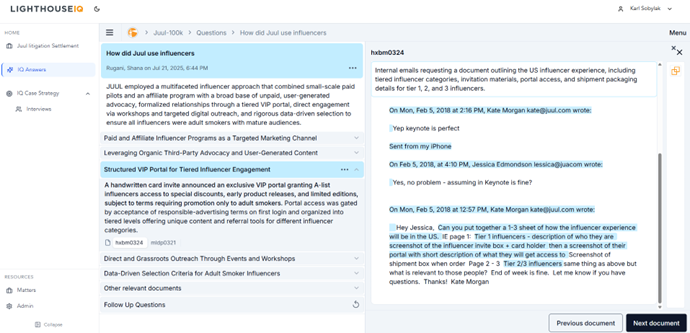
Image Source: Lighthouse Global Marketing
Team
The bottom line is that most enterprise AI is still in the proof-of-concept business. LighthouseIQ is not. It has run on million-document matters under Department of Justice and Federal Trade Commission scrutiny and the outputs were accepted.
Vendors promise production-ready AI. Procurement teams run pilots on sanitized data. Then the real matter arrives – millions of documents, a regulatory deadline, and a legal team that cannot afford an error – and the tool quietly stops working as advertised.
LighthouseIQ is trying to fill the subsequent gap. The platform is generally available, already deployed on high-stakes eDiscovery matters, and has produced outputs accepted by federal regulators. Whether that holds at your organization's scale and risk profile is an open question. The difference from most AI vendors is that there is now evidence to evaluate, not just claims.
What Was Announced
Lighthouse announced general availability of LighthouseIQ on January 21, 2026, an AI intelligence platform built specifically for eDiscovery. Ron Markezich, who joined Lighthouse after 24 years at Microsoft building globally scaled applications, described the platform as the result of three years of deliberate development and pressure-testing on live matters. It runs on two layers: domain-specific applications at the top and IQ Fabric, a foundational intelligence layer, underneath.
IQ Fabric handles data ingestion, processing, cognition, and workflow orchestration across diverse sources and formats. Four applications sit on top of it: IQ Answers for early case intelligence, IQ Case Strategy for litigation planning, IQ Review for relevance classification at scale, and IQ Priv for privilege identification and log generation.
Lighthouse built IQ to sit alongside existing platforms, not displace them. Relativity integration is a stated design priority. That is a pragmatic choice, and probably a commercially necessary one, but it also means IQ's value is partly contingent on how clean those integrations actually are in practice.
What Is the Business Value
The core promise is defensible speed at scale. Legal teams can interrogate incomplete, in-flight datasets using natural language and get cited answers before downstream review even starts. Privilege identification and logging, historically among the most expensive and error-prone phases of discovery, are handled at machine speed with claimed auditability.
The results Lighthouse has published since launch are specific. On a matter involving more than 20 million documents at Arnold & Porter, IQ Case Strategy avoided a large-scale review effort entirely, producing an estimated $7.7 million in savings according to Lighthouse. On a separate benchmark comparing workflows on the same dataset, LighthouseIQ surfaced key documents in three hours against three weeks for the prior continuous active learning review, a 40 times compression in time to insight, according to Lighthouse. Across its customer base, Lighthouse reports 1.4 billion documents analyzed and throughput of up to 33 million documents per day on individual matters.
Those figures are vendor-supplied. They are also specific enough to be testable. The harder question, one Lighthouse does not fully answer in its public materials, is what error rates look like at that volume, and how errors are caught and corrected before they reach opposing counsel or a regulator.
For enterprises, the appeal is lower outside counsel spend, faster regulatory response, and fewer late-stage surprises. The CFO cares about cost compression on review. The general counsel cares about defensibility under scrutiny. Organizations evaluating LighthouseIQ should be clear about which problem they are actually trying to solve before they start the conversation.
Why This Matters Beyond Legal Technology
eDiscovery is one of the few enterprise domains where AI outputs are immediately stress-tested by adversarial parties, opposing counsel, federal regulators, and judges. There is no quiet failure mode. That makes it a useful proxy for how AI performs when the consequences of error are visible and immediate.
LighthouseIQ is designed for organizations where legal, compliance, information technology, and data governance must operate on the same intelligence layer. Most AI initiatives stall at exactly those organizational seams. The platform is built to cross them by design. Whether it does this in practice depends heavily on how those functions are actually structured at a given organization.
For CTOs and heads of AI, the broader signal is this: domain-specific architecture built for a regulated, adversarial environment is a materially different engineering problem than building a general-purpose copilot. The companies that solve it in one domain will have a template for others.
Competitive Landscape
The named competitors are Relativity, Everlaw, Reveal, Epiq, Consilio, and DISCO, all of which are layering generative AI onto established review workflows. Indirect competition comes from large contract review teams and consulting-led approaches that wrap generic AI in custom processes. Lighthouse is arguing against both the retrofitted platforms and the human-intensive services model.
The harder competitive question is what happens when Relativity, which still anchors most enterprise eDiscovery workflows, deepens its own AI capabilities. Lighthouse's integration-first approach is sound positioning today. It becomes more complicated if Relativity closes the gap on AI functionality while tightening its ecosystem.
Lighthouse is also implicitly competing against the belief that a horizontal AI platform, a general-purpose large language model with a good prompt, can be configured to handle regulated discovery. The launch pushes back on that directly. The argument is credible. It is not yet definitive.
What Is Actually Different Here
The differentiation is not the use of AI. It is the evidence of survival under pressure. Outputs accepted by the Department of Justice and Federal Trade Commission in second-request matters represent a bar that most AI tools in this space have never been required to clear.
What makes that possible is less about the models and more about the infrastructure: data pipelines that handle messy, incomplete datasets; workflows with audit trails that hold up to scrutiny; and human practitioners in the loop at the right points. Lighthouse is not claiming the AI works autonomously. That restraint is itself a form of differentiation in a market full of overclaiming.
Named firms including Cleary Gottlieb, Arnold & Porter, Kirkland & Ellis, Baker Botts, and Reed Smith have described using LighthouseIQ on active matters with specific outcomes. That roster is not a reference list. It is evidence that the platform operates at the level of complexity these organizations routinely encounter.
What Lighthouse has not fully demonstrated publicly is how the system performs when it is wrong, how errors surface, who catches them, and what the correction workflow looks like. That is not a knock. It is an unresolved question that any serious buyer should press on before deployment.
How to Evaluate This in the Next 30 to 90 Days
Run IQ Answers on a real, messy dataset, not a curated sample provided by Lighthouse. Early case intelligence only has value if it works before data is clean or fully processed. A vendor that needs clean inputs to perform is describing a constraint, not a capability.
Pressure-test the privilege workflow specifically. Ask how outputs are audited, how errors are flagged, and what the correction process looks like when privilege calls are challenged. This is where AI systems most commonly fail under adversarial conditions, and where the liability exposure is highest.
Evaluate integration depth with your actual stack, not a reference architecture. IQ's value depends on how cleanly it connects to your existing eDiscovery and data governance infrastructure. Loose integrations introduce latency and accuracy risk that can undermine the core claims.
Ask the defensibility question directly: when a regulator or opposing counsel challenges a LighthouseIQ output, where does the defense actually rest? In the model? The workflow? The human practitioner? Lighthouse's ongoing operational involvement? That answer determines whether you own the risk or are renting someone else's infrastructure to manage it.
Our Take
LighthouseIQ is one of the clearest examples to date of enterprise AI moving from experimentation into institutional infrastructure. What stands out is not the interface. It is the evidence that this system has survived real regulatory, legal, and scale pressure.
This is not a product for organizations looking to dabble in AI or reduce headcount through automation alone. It is built for teams already operating in high-risk, high-cost discovery environments who want leverage without increasing exposure. The decision to enhance rather than replace existing platforms signals maturity, not lack of ambition.
IQ Fabric is built as a reusable intelligence layer, not a one-off eDiscovery feature set. If Lighthouse executes on that architecture, this begins to look less like legal tech and more like regulated AI infrastructure for high-risk data domains.
The companies that figure out how to operationalize AI under adversarial, regulated conditions will have a template that transfers. Most AI initiatives are still optimizing for demo performance. LighthouseIQ is optimizing for what happens when a federal regulator reviews the output.