Adobe Targets the Next Phase of Customer Experience: Humans and AI Agents
Adobe introduced CX Enterprise as an agentic AI platform designed to help brands create content, improve visibility in AI-driven discovery, and orchestrate personalized engagement.
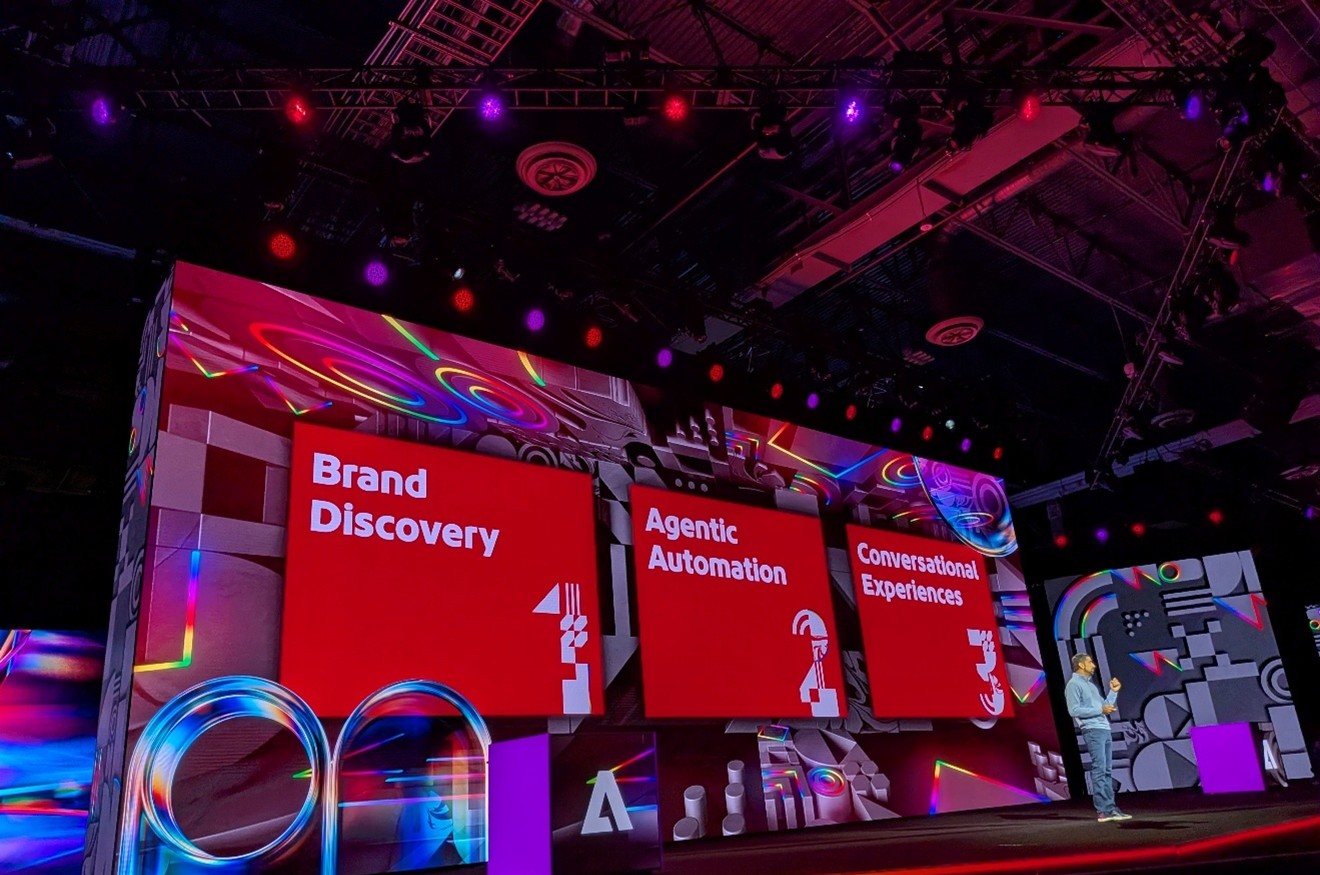 Info-Tech Research Group, 2026
Adobe Summit 2026 focused on how customer experience is moving into an environment where brands must serve both human buyers and AI agents. Enterprise teams need systems to keep up with the speed and complexity of that shift.
The main announcements fell into four connected areas:
First, Adobe introduced CX Enterprise, describing it as an end-to-end agentic AI system that brings together AI agents, agent skills, model context protocol (MCP) endpoints, and governance in one orchestrated platform for customer experience. The platform also includes a new agent catalog and developer tools designed to support teams building and extending agentic workflows.
Second, Adobe framed content supply chain, brand visibility, and customer engagement as the three main pillars of CX Enterprise. In simple terms, that means helping teams create on-brand content, improve how the brand appears in AI-driven discovery, and use customer data to manage more personalized engagement.
Third, Adobe positioned CX Enterprise Coworker as a core element of the customer engagement pillar, helping coordinate work across agents and teams to plan, execute, and track against business goals.
Fourth, Adobe announced a significant expansion of its partner ecosystem, with strategic partnerships across leading technology platforms and global agencies reinforcing the interoperability ambitions of CX Enterprise.
Taken together, Adobe is signaling that it is building the AI infrastructure necessary to support an enterprise operating layer for agentic customer experience.
Content Supply Chain: Brand Intelligence for the Agentic Era
Under the content supply chain pillar, Adobe introduced Brand Intelligence, described as a continuously-learning engine for on-brand content creation. New agentic solutions built around Brand Intelligence streamline cross-team collaboration, campaign brief creation, and creative production. In Adobe's framing, marketers now need content that is immediately accessible, semantically clear, and governed tightly enough that AI systems can use it without distorting the brand. That is a meaningful shift in the work itself.
Adobe's demos showed how brand rules, product data, localization constraints, and structured content can be combined into AI workflows, allowing marketers to react more quickly to changing demand or emerging trends. The main bottleneck has often been execution. Organizations may spot an opportunity quickly but still need to create, review, localize, and publish content fast enough to matter. Adobe's message is that agentic systems can shorten that cycle while preserving human oversight and brand governance.
The practical implication for end users is that Brand Intelligence becomes less of a passive guidance layer and more of an operating mechanism. It helps determine what content should be created, how it should be framed, and whether it remains aligned to brand requirements as it moves into channels where AI systems are increasingly the first point of interpretation.
Brand Visibility: Competing in AI-Mediated Discovery
One of the clearest messages from Summit 2026 was that brand visibility is now harder because brands are no longer competing only for human attention. They are also competing for how agents and LLMs interpret, rank, and return them.
The brand visibility pillar addresses a parallel challenge: how brands are found and represented across AI-driven discovery surfaces. Adobe has expanded Adobe Experience Manager with contextual layers for AI agent–driven experience optimization. Newer tools, including Adobe LLM Optimizer and Brand Concierge, are designed to help brands improve visibility across AI discovery surfaces and support more direct customer engagement.
This matters because discovery is increasingly about what an AI intermediary can read, understand, and recommend. Brand visibility is Adobe's response to that structural shift, giving enterprise teams the tools to manage how their brand is interpreted and surfaced by AI systems operating on behalf of buyers.
The acquisition of SEMrush is likely to strengthen this approach by introducing behavioral data derived from LLM-mediated traffic, expanding Adobe’s ability to analyze and optimize for AI-driven discovery patterns.
Customer Engagement: Engagement Intelligence and Journey Orchestration
The third pillar, customer engagement, is designed to orchestrate personalized experiences across every touchpoint, moving businesses from siloed campaigns to continuous, agentic AI–powered engagement. It integrates data, content, and journey orchestration to enable one-to-one personalization at scale. Adobe Journey Orchestrator and Real-Time CDP sit within this pillar, alongside CX Enterprise Coworker.
Engagement Intelligence is a central element of CX Enterprise, functioning as the decisioning engine that optimizes customer lifetime value and enables personalization at scale. It works alongside Brand Intelligence to power the orchestration of personalized customer journeys, synthesizing data from Adobe Experience Platform and other enterprise systems to deliver actionable insights, recommend next-best actions, and monitor engagement across all touchpoints.
Engagement Intelligence is embedded in agentic workflows, allowing agents and Coworker to act on real-time engagement signals and optimize outcomes continuously. It enables agents to reason against governed data and operate within defined business objectives, ensuring customer interactions remain relevant and measurable. It supports Adobe Journey Optimizer Loyalty, CX Analytics, and Real-Time CDP, providing unified, governed insights for journey optimization, campaign performance, and loyalty experiences.
Importantly, Engagement Intelligence is also accessible beyond Adobe's own ecosystem. It integrates with partner platforms including Microsoft 365 Copilot, Anthropic Claude, Amazon QuickSight, ChatGPT Enterprise, Google Gemini, and IBM watsonx Orchestrate, ensuring teams can leverage customer experience intelligence wherever they work.
Many enterprises are trying to move beyond batch-based orchestration toward more fluid, context-driven engagement. The emphasis within customer engagement is moving away from isolated journey design and toward activating journey logic using enterprise context, outside inputs, audience intelligence, and AI-supported decision-making. If Adobe can deliver that consistently, this pillar becomes more valuable as part of a continuous operating model where journeys respond intelligently to real-world signals and work naturally alongside AI-generated content and recommendations.
CX Enterprise Coworker Connects Across CX Systems
CX Enterprise Coworker was among the most significant announcements from the event. Adobe described it as a collaborative AI teammate that can operate across Adobe products, enterprise systems, and outside-world signals while orchestrating both Adobe agents and enterprise-specific agents. The significance is that it represents a proposed shift in how work gets done, away from a model where users navigate individual applications and toward one where AI acts across capabilities with humans setting goals and governing outcomes.
Adobe confirmed at Summit that humans remain a critical part of the creative process, working alongside agentic AI to drive creativity, oversight, and strategic decision-making. The platform is designed to enhance human capabilities by automating repetitive tasks, surfacing actionable insights, and maintaining enterprise-scale governance and control.
For enterprise teams, customer experience environments have become too fragmented to manage efficiently through manual coordination alone. Coworker is Adobe's proposed answer to that fragmentation. If it performs as described, it could meaningfully reduce the operational overhead involved in moving between analytics, audiences, journeys, approvals, content actions, and external triggers.
Ecosystem Expansion Through Strategic Partnerships
A key dimension of Adobe's Summit announcements was the significant expansion of its partner ecosystem. Adobe is collaborating with leading technology companies (including Amazon Web Services, Anthropic, Google Cloud, IBM, Microsoft, NVIDIA, and OpenAI) alongside a broad group of global agencies and system integrators: Dentsu, Havas, Omnicom, Publicis, Stagwell, WPP, Accenture, Capgemini, Cognizant, Deloitte Digital, EY, Infosys, PwC, and TCS.
These partnerships are designed to enable seamless multi-agent collaboration, frictionless workflows, and deep interoperability across platforms. The practical effect is that CX Enterprise is not intended to operate in isolation. It is designed to connect with the broader enterprise software landscape, helping brands deliver customer experiences and business outcomes across the systems and platforms they already use.
Adobe is a platform that extends well beyond just marketing. The e-commerce return on investment cases from Summit, including Ulta Beauty and Dick's Sporting Goods, were the most visible proof points, but they represent a narrow slice of where Adobe runs in the enterprise.
Summit also made a credible case for intent-driven page composition: experiences that assemble based on what the system knows about who is arriving and why, rather than assuming the visitor will navigate a menu. The e-commerce cases made this visible because purchase intent is measurable, but the infrastructure requirement is the same regardless of industry. Content must be structured and tagged for retrieval. Visitor data must be unified and actionable in real time. That is a technology decision before it is a creative one.
Adobe customers succeed when marketing and technology leadership share accountability for the platform. That alignment is not only these use cases but a prerequisite for every enterprise.
Our Take
This is a more mature AI message than many vendors are offering. Adobe focused less on novelty and more on what enterprises need to run AI at scale: context, governance, orchestration, and cross-system integration.
Within CX Enterprise, the three pillars address the full arc from creation to discovery to engagement. Content supply chain helps teams produce governed, AI-ready content at speed. Brand visibility addresses how brands are interpreted and surfaced in AI-mediated discovery. Customer engagement (anchored by Engagement Intelligence, journey orchestration, and Coworker) turns signals and decisions into personalized actions across the customer lifecycle. The partnership ecosystem extends that reach into the platforms where enterprise work actually happens.
And while Adobe's innovations are strategically important, recent examples of AI mislabeling photos with NSFW tags reinforce a basic operational reality: human oversight still determines whether AI creates enterprise value or enterprise risk.