Zoho Announces AppOS, Moving From Integrated Apps to a Unified Platform Model
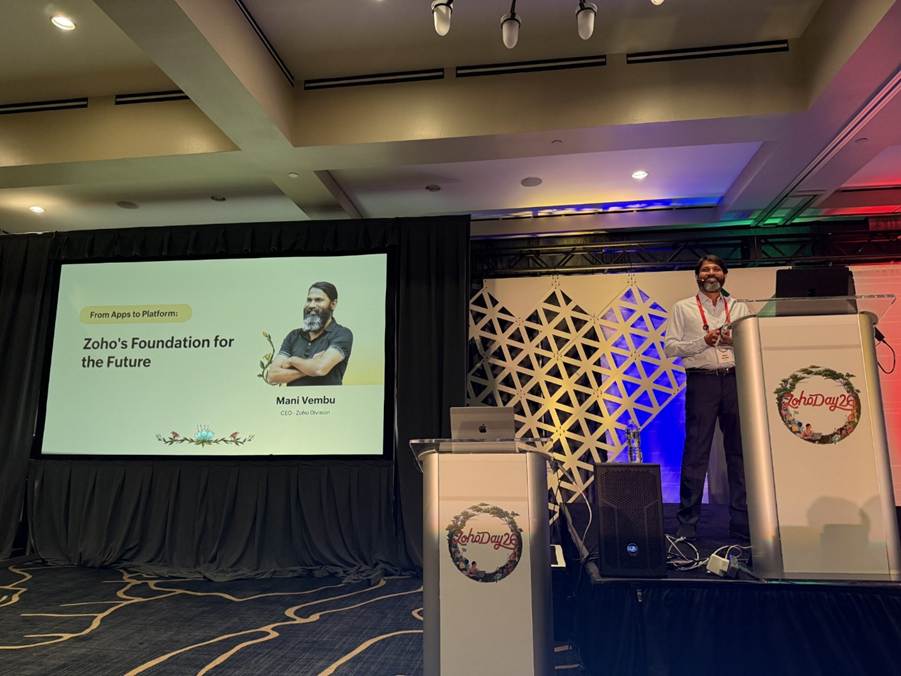
Zoho CEO Mani Vembu announces AppOS at ZohoDay26. Source: Thomas Randall
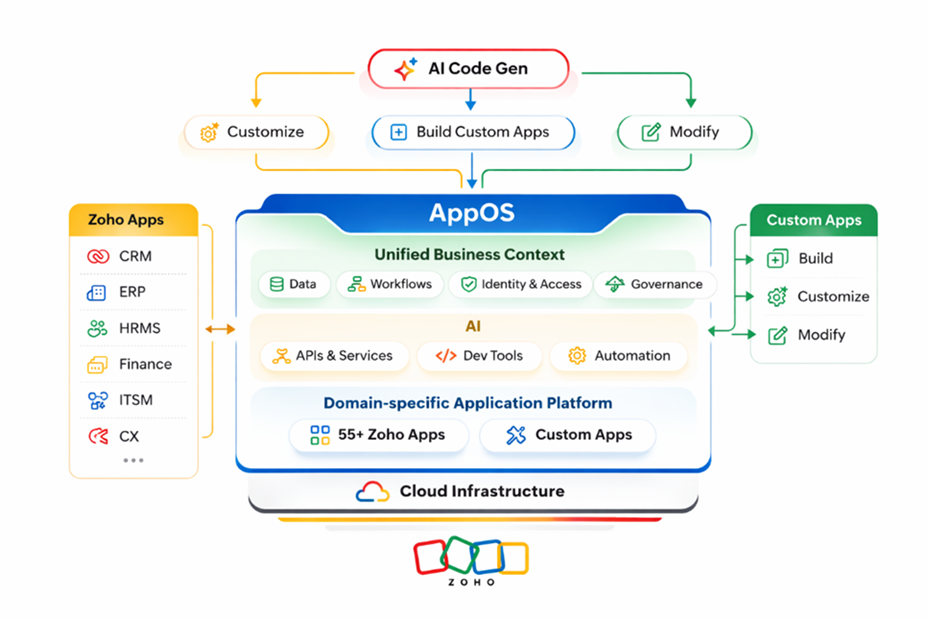
At ZohoDay26, Zoho CEO Mani Vembu outlined Zoho’s shift “from apps to platform,” previewing AppOS as a planned architectural layer across its ecosystem. Influenced in part by Apple’s response to mobile app fragmentation through iOS, AppOS will be a future platform layer sitting above infrastructure and below applications, supporting more than 55 Zoho applications and custom-built apps. Especially in response to “vibe-coding” practices, AppOS will be the framework that developers will operate in when building within the Zoho platform; by default, AppOS embeds common process models, structured data schemas, built-in workflows, identity services, permissions, governance controls, APIs, developer tooling, and automation services. General availability for AppOS is expected in H2 2026.
Zoho’s vision for AppOS reflects their go-to-market strategy for SaaS consolidation. Many organizations operate large SaaS portfolios where integrations connect systems, but underlying data logic and governance models [WS1.1][TR1.2]remain fragmented. Zoho’s position is that this fragmentation complicates AI initiatives, increases security exposure, and drives operational complexity. AppOS’s value proposition is to mitigate these pain points, enforcing shared standards across the Zoho ecosystem – ultimately encouraging users to consolidate on the Zoho platform.
Source: Screenshot from ZohoDay26, with permission to share by Zoho
A driving force behind AppOS is consistency and efficiency in AI code generation. Zoho’s framework defines business logic, data structures, identity controls, and governance rules before generating application code. Zoho asserts this approach reduces duplication and system drift while accelerating development. If executed as described, a unified architecture could streamline governance and development for organizations standardized on Zoho.
As the capability is still in preview, independent validation and production-scale customer evidence are not yet available.
Our Take
AppOS represents a forward-looking consolidation strategy for Zoho. For organizations already invested in Zoho (and willing to keep more of their operational surface area inside Zoho) AppOS would improve governance consistency across applications. A shared identity, workflow, and data layer has clear upside when most business logic and records live natively in Zoho apps. There is a meaningful value proposition here: Zoho is enabling builders (including developers leveraging AI-assisted or “vibe” coding approaches) to create within a structured framework where standards are embedded by default rather than applied after the fact.
The Unified Business Context layer comprising data, workflows, governance and access management could become the foundation for the Autonomous Enterprise, if properly designed and implemented. However, it also could become a bottleneck if it is implemented as an old-fashioned centralization layer. For example, the data component must accommodate data diversity by type (transactional, master records, unstructured, synthetic, etc.), architectural domain (operational vs. analytical), functional domain (sales, operations, finance, etc.), sensitivity (public, internal, restricted, etc.) – all overlayed with proper data consumption model (primary vs. derived data products). A centralized, actionable business capability model with value streams and core conceptual model of the organization (something similar to Ontology in the new Microsoft IQ layer) would be highly beneficial and can lay the basis for enterprise-wide workflow and governance management. We shall closely watch further developments in this layer.
While the previous concern relates to architectural design inside the platform, there is also a broader strategic implication for organizations that have heterogeneous enterprise environments. AppOS is positioned as “applications built inside the platform,” which implicitly rewards unification more than heterogeneity. In that sense, Zoho’s messaging about customer flexibility must be interpreted carefully: Flexibility exists within the platform, but the architecture itself encourages consolidation. The platform becomes more valuable when shared process models, governance, and data structures are enforced natively rather than mediated across system boundaries. Zoho’s approach parallels strategies taken by other enterprise platform providers, such as ServiceNow, which have strengthened their AI and workflow propositions by reducing fragmentation through platform centralization.
By contrast, Microsoft is moving in a more federated direction; their newly released Foundry IQ is designed to span multiple knowledge sources, presenting a single endpoint for agent grounding while respecting user permissions. Microsoft’s integration approach for agents leans on connectors-as-tools, allowing systems such as SAP, ServiceNow, Salesforce, GitHub, and SQL to be accessed within the governance framework of Microsoft’s AI stack. In this model, the control plane and governance layer sit in Microsoft’s ecosystem, but operational systems can remain distributed.
Zoho’s approach is strategically aligned with its long-standing philosophy of owning the full stack experience. If executed with depth and operational maturity, AppOS could meaningfully strengthen Zoho’s platform gravity and simplify AI-era governance for committed customers. The key consideration for organizations will be whether AppOS aligns with their architectural direction toward consolidation or federation.
Want to Know More?
- Build an Enterprise Application Integration Strategy | Info-Tech Research Group
- Build Your EA Practice Strategy | Info-Tech Research Group
- Govern the Use of AI Responsibly With a Fit-for-Purpose Structure | Info-Tech Research Group
- Define a Data Practice Strategy to Power an Autonomous Enterprise | Info-Tech Research Group
- Microsoft Adopts Ontology-Based IQ Layer for Agentic AI